Trafficking in persons

Trafficking happens in Canada. But Canadian law does not protect trafficked persons.
Currently, women, children and men who are trafficked into or within Canada often fall between the cracks in the system. Detained and deported, they may be treated more as criminals than as victims of a crime.
Legislative amendment is needed to bring a permanent and fundamental change in policy so that trafficked persons in Canada are protected.
Trafficking
- Involves the exploitation of people, often through forced labour. Those who are trafficked may be engaged in exploitative conditions in sex work, domestic work, in the service industry (e.g. restaurants) or in manufacturing.
- Often involves the transportation of victims across borders or within a country. People who are far from their home communities are much easier to exploit, because of their isolation in an unfamiliar community. This is true of people brought into Canada, but also of people transported within Canada, such as aboriginal people separated from their nation.
- Exploits the vulnerable. This is why women and children are often the victims. Traffickers often rely on the very limited options available to people, especially women, in desperately poor communities. Trafficked persons are often unaware of the rights they do have and traffickers will try to keep them ignorant.
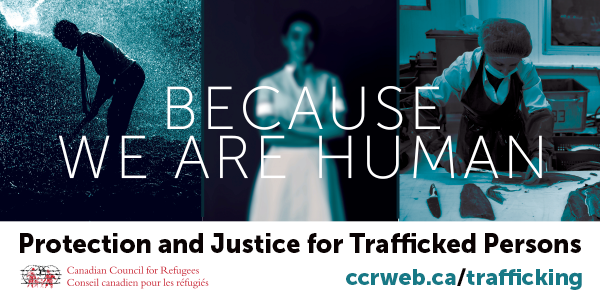
- Affects people who are first of all human beings, not victims. Those who are trafficked are individuals with their own stories and, within the constraints of their circumstances, often extremely difficult, they have made choices about their lives. They deserve respect and greater control over their own lives.
Trafficking in Canada
Trafficking is a term that focuses on the international dimensions of the problem. While this is important, it can be misleading in that it may suggest that trafficking is a "foreign" problem that has been imported from abroad. It is therefore important to recognize that trafficking is a form of forced labour and that it responds to demands in Canada. It is a Canadian problem.
Canadian law criminalizes trafficking, rightly treating it as a very serious crime and imposing heavy penalties on those found guilty of trafficking. However, the only place in the Immigration and Refugee Protection Act where trafficked persons are mentioned is in the regulation which includes having been trafficked as a factor in favour of detention, including for children. There is nothing in the law to protect the rights of trafficked persons specifically.
Temporary Residence Permits
In May 2006, the Canadian government issued new guidelines for temporary residence permits for victims of human trafficking (see news release: ‘Assistance for victims of human trafficking’). The CCR welcomed the move as a step in the right direction (see release CCR welcomes emergency protection measure for trafficked persons).
However, in the view of the CCR, the temporary residence permits have proven inadequate: they are discretionary and are not always offered to trafficked persons; they impose an unreasonable burden of proof on the trafficked person; and the mandatory involvement of law enforcement agencies has deterred some trafficked persons from applying.
In 2007, after the new guidelines were issued, a woman was apprehended at the US-Canada border. The Canadian authorities interviewed her and concluded that she had been trafficked. However, she was not offered any protection – instead she was held in detention and quickly deported, without even being given the opportunity to meet with a lawyer.
Learn more about Trafficking
In recent years there has been a significant increase worldwide in discussion about the problem of trafficking. The abuses of the basic human rights of trafficked persons, who are mainly women and girls, arouse great concern. NGOs, governments, the United Nations and others have attempted to respond to the problem. However, there are many different opinions about what trafficking is, how widespread trafficking is, how to understand the problem and what needs to be done to respond to it and to address the growing restrictions against legal and safe migration that people around the world are facing. Learn more.
The CCR and efforts to protect trafficked persons
The CCR is calling for measures to adequately protect the rights of trafficked persons in Canada, in particular through legislative amendment. The CCR also urges Canadians to educate themselves about the realities of trafficking and to take action in favour of the rights of trafficked persons.
Goals of the Canadian Council for Refugees' campaign:
-
Permanent and fundamental change in policy so that trafficked persons in Canada are protected and their human rights respected.
- Increased public awareness of the reality of trafficking in persons in Canada.
Guiding Principles
The CCR has identified the following principles to guide responses to trafficking:
- Non-punitive: Measures must not penalize trafficked persons
- Human rights: Measures must be guided by and be respectful of the human rights of trafficked persons
- Economic rights: Measures must be guided by and be respectful of the economic rights of trafficked persons
- Supportive services: There is a need for supportive services for trafficked persons
- Gender and race analysis: A gender and race analysis should be brought to any consideration of trafficking issues
- Inclusive of trafficked persons: Discussions about trafficked persons should include trafficked persons themselves
Proposal for legislative amendment to protect trafficked persons
The CCR has developed a Proposal to amend the Immigration and Refugee Protection Act. The proposal would provide temporary and permanent protection to trafficked persons. The CCR is calling on Parliamentarians to turn this proposal into law.
Useful resources:
| Proposal for Legislative Amendment to Protect Trafficked Persons (also available in htm), 2 pages. |
![]() |
Take action, 2 pages. |
| Frequently Asked Questions about the Proposal for Legislative Amendment to Protect Trafficked Persons, 4-page booklet. |
Protecting Trafficked Persons in Canada, pamphlet. |
|
| Order form for resources (pdf). |
CCR Trafficking Resources Database
The CCR has launched a database of human trafficking resources, providing access to tools for raising awareness about trafficking, and for providing services to trafficked persons. Explore the database of trafficking resources.
Learn more about the CCR's efforts to protect trafficked persons accross Canada.